
MultiFlexi Architecture
The MultiFlexi ecosystem is composed of several interrelated projects, each fulfilling a specific role in the overall architecture. Below is an overview of the main member projects and their relationships:
Core Components
php-vitexsoftware-multiflexi-core (https://github.com/VitexSoftware/php-vitexsoftware-multiflexi-core)
The core PHP library providing the main business logic, data models, and shared utilities for the MultiFlexi platform. All other components depend on this package for core functionality.
multiflexi-database (https://github.com/VitexSoftware/multiflexi-database)
Contains database schema definitions and migration scripts for MultiFlexi. Used by the server and other components to initialize and update the database structure.
multiflexi-cli (https://github.com/VitexSoftware/multiflexi-cli)
Command-line interface for managing MultiFlexi resources (applications, companies, users, jobs, etc.). Relies on the core library and interacts with the database.
multiflexi-server (https://github.com/VitexSoftware/multiflexi-server)
The main backend server providing REST API for MultiFlexi. It orchestrates job scheduling, user management, and integrates with the core library and database. It serves as the data provider for the web and CLI interfaces.
multiflexi-web (https://github.com/VitexSoftware/multiflexi-web)
The primary web interface for MultiFlexi. It provides a responsive dashboard, application configuration tools, and real-time monitoring of job execution.
multiflexi-executor (https://github.com/VitexSoftware/multiflexi-executor)
A dedicated service or agent responsible for executing jobs and tasks as scheduled by the server. Communicates with the server and may run in isolated environments.
multiflexi-ansible-collection (https://github.com/VitexSoftware/multiflexi-ansible-collection)
An Ansible collection providing playbooks and roles for deploying and managing MultiFlexi components in various environments.
multiflexi-zabbix (https://github.com/VitexSoftware/multiflexi-zabbix)
Contains Zabbix monitoring integration, including Low-Level Discovery (LLD) scripts and pre-configured Zabbix templates.
multiflexi-all (https://github.com/VitexSoftware/multiflexi-all)
A meta-repository that aggregates all the above projects, providing a unified source for development, deployment, and integration.
Project Relationships
The core library is a dependency for the CLI, server, and executor.
The database project provides schema and migrations for all components that require persistent storage.
The CLI and web both interact with the server (via REST API), database, and core library, but serve different user interfaces.
The executor is managed by the server and is responsible for running jobs in a secure and isolated manner.
The ansible-collection is used to automate deployment and configuration of all components.
The all meta-repo is used for orchestration, CI/CD, and as a reference for the complete MultiFlexi stack.
This modular architecture allows for flexible deployment, scaling, and maintenance of the MultiFlexi platform.

MultiFlexi project relationships schema
Scheduling and Execution Process
MultiFlexi uses a sophisticated scheduling system that handles job creation, queuing, and execution across multiple environments. Starting with version 2.x, the system uses dedicated systemd services instead of traditional cron jobs.
System Services
MultiFlexi 2.x+ operates with two dedicated systemd services:
multiflexi-scheduler.service: Continuously runs the scheduling daemon that creates job records
multiflexi-executor.service: Continuously polls for scheduled jobs and executes them
Both services run as daemon processes under the multiflexi user and are configured via /etc/multiflexi/multiflexi.env.
Phase 1: Scheduling (multiflexi-scheduler daemon)
The scheduling daemon (/usr/lib/multiflexi-scheduler/daemon.php) runs continuously in a loop and:
Loads all active companies from the database
Retrieves RunTemplates that are ready to be scheduled (
active=true,next_schedule=null,interv != 'n')Determines the scheduling interval:
Custom cron expressions (
interv='c'): Uses the cron expression directly from thecronfieldStandard intervals (
i/h/d/w/m/y): Converts shorthand notation to full cron expressions using the$intervCronmapping:i(minutely) →* * * * *h(hourly) →0 * * * *d(daily) →0 0 * * *w(weekly) →0 0 * * 1(Monday)m(monthly) →0 0 1 * *y(yearly) →0 0 1 1 *
Parses the cron expression using the
dragonmantank/cron-expressionlibraryCalculates the next run time with
getNextRunDate()Applies optional startup delay if configured
Creates a new Job record via
prepareJob()
Phase 2: Job Creation
During job creation:
A new record is inserted into the
jobtable with:runtemplate_id: Reference to the RunTemplatecompany_idandapp_id: Company and application identifiersschedule: Calculated execution timestampexecutor: Selected executor type (Native, Podman, Docker, etc.)env: Serialized environment variables from merged configurations
Environment variables are assembled from multiple sources:
Application-level configuration
Company-specific settings
Custom overrides from the RunTemplate
The job is scheduled by inserting a record into the
scheduletable with theaftertimestampThe RunTemplate’s
next_schedulefield is updatedOptional monitoring metrics are sent to Zabbix (phase: ‘prepared’)
Optional OpenTelemetry trace spans are created for job lifecycle tracking
Phase 3: Job Execution (multiflexi-executor daemon)
The execution daemon (/usr/lib/multiflexi-executor/daemon.php) runs continuously and:
Periodically polls the
scheduletable for jobs whereafter < NOW()(default: every 10 seconds, configurable viaMULTIFLEXI_CYCLE_PAUSE)Loads the associated Job record and deserializes the environment
Selects the appropriate executor based on the job configuration:
Native Executor: Uses Symfony Process to run commands directly on the host machine with full environment variable support
Podman Executor: Runs the job in an isolated container with
podman runDocker Executor: Similar to Podman but using Docker containers
Azure/Kubernetes: Cloud-based execution in managed environments
The executor:
Constructs the command line from
executable+cmdparamsLaunches the process with the prepared environment
Captures real-time stdout and stderr output
Tracks the process ID (PID)
Monitors execution progress
After execution completes:
Updates the
jobtable with results:exitcode: Process exit statusstdoutandstderr: Captured outputbeginandend: Execution timestampspid: Process identifier
Updates RunTemplate statistics (
successfull_jobs_countorfailed_jobs_count)Deletes the entry from the
scheduletableSets
next_schedule=NULLand updateslast_scheduleSends final metrics to Zabbix and OpenTelemetry
Logs the execution to the SQL logging system
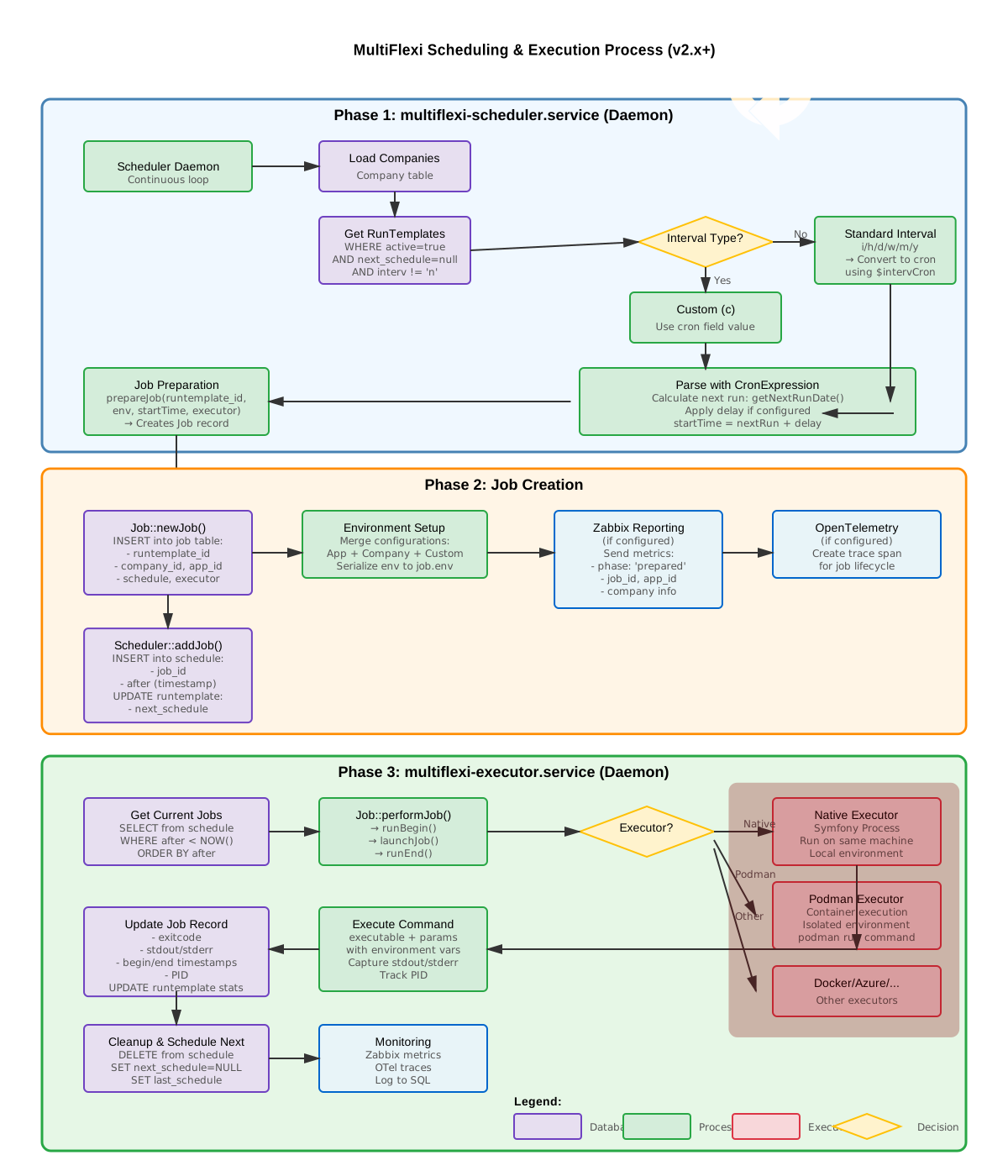
Complete flow of job scheduling, creation, and execution in MultiFlexi
Daemon Configuration
The daemon services can be controlled via environment variables in /etc/multiflexi/multiflexi.env:
Scheduler Daemon:
MULTIFLEXI_DAEMONIZE=true: Run continuously (default) or exit after one cycle
Executor Daemon:
MULTIFLEXI_DAEMONIZE=true: Run continuously (default) or exit after one cycleMULTIFLEXI_CYCLE_PAUSE=10: Seconds between polling cycles (default: 10)MULTIFLEXI_MEMORY_LIMIT_MB=1800: Soft memory limit in MB for graceful shutdown before OOMMULTIFLEXI_MAX_PARALLEL=4: Maximum concurrent jobs (requires pcntl extension; 0 for unlimited)
The executor daemon includes:
Memory monitoring: Proactively exits when approaching the memory limit to prevent OOM kills
Database resilience: Handles transient database failures with retries; exits on permanent errors (auth, missing database)
Graceful cleanup: Ensures proper shutdown with logging on exit
Key Design Principles
Continuous Operation: Both scheduler and executor run as systemd services, eliminating dependency on system cron
Separation of Concerns: Scheduling (multiflexi-scheduler), job management (Job class), and execution (multiflexi-executor) are separated into distinct services
Database-Driven Scheduling: The
scheduletable acts as a persistent queue, ensuring no jobs are lost even if services restartFlexible Execution: Multiple executor types allow jobs to run in different environments based on requirements
Environment Isolation: Each job has its own serialized environment, preventing interference between executions
Comprehensive Monitoring: Integration with Zabbix and OpenTelemetry provides visibility into the entire lifecycle
Incremental Scheduling: Jobs are scheduled one run at a time (
next_scheduleis set after execution), preventing duplicate schedulingResource Management: Memory limits and parallel execution controls prevent resource exhaustion
Credential Management Architecture
MultiFlexi implements a sophisticated three-tier credential management system that provides secure, reusable, and flexible authentication handling across the entire platform. This architecture ensures clear separation between credential templates, company-specific implementations, and actual usage.
Three-Tier Credential System
The credential management follows a hierarchical relationship:
CredentialPrototype → CredentialType → Credential
┌─────────────────────┐
│ CredentialPrototype │ (JSON Templates - Global)
│                     │
│ • JSON schema       │
│ • Field definitions │
│ • Validation rules  │
│ • Reusable across   │
│   companies         │
└──────────┬──────────┘
           │ instantiated as
           ▼
┌─────────────────────┐
│   CredentialType    │ (PHP Classes - Company Scoped)
│                     │
│ • PHP implementation│
│ • Company-specific  │
│ • Business logic    │
│ • UUID tracking     │
└──────────┬──────────┘
           │ provides schema for
           ▼
┌─────────────────────┐
│     Credential      │ (Values - Application Usage)
│                     │
│ • Actual values     │
│ • Encrypted storage │
│ • Used by jobs      │
│ • RunTemplate refs  │
└─────────────────────┘
Database Schema Relationships:
credential_prototype (1) ←→ (∞) credential_prototype_field
        ↓ (1:∞)
credential_type ←→ (1:1) company
        ↓ (1:∞)
credentials ←→ (∞:1) runtemplate
           ←→ (∞:1) application
- Tier 1: CredentialPrototype (JSON Templates)
Purpose: Define reusable credential schemas and field structures
Storage:
credential_prototypeandcredential_prototype_fieldtablesFormat: JSON-based templates with field definitions, types, validation
Scope: Global templates available to all companies
Management:
multiflexi-cli crprototypecommands
- Tier 2: CredentialType (Company Instances)
Purpose: Company-specific implementations of credential prototypes
Storage:
credential_typetable with UUID supportImplementation: PHP classes implementing
CredentialTypeInterfaceScope: Company-isolated instances
Management:
multiflexi-cli credential-typecommands
- Tier 3: Credential (Application Usage)
Purpose: Actual credential values used by applications and jobs
Storage:
credentialstable with encrypted sensitive dataUsage: Referenced by RunTemplates and job executions
Scope: Specific credential instances for operational use
Management: Web interface and CLI tools
Security and Isolation Features
- Multi-Tenant Security
Company-scoped credential types prevent cross-tenant access
Database-level isolation enforced through foreign key constraints
Role-based access controls limit credential management permissions
- Encryption and Protection
Sensitive fields (passwords, API keys) encrypted at rest
Separate encryption key management from credential storage
Secure credential field transmission between components
- Audit and Compliance
Complete audit trail for all credential operations
GDPR-compliant data handling and deletion capabilities
Secure credential rotation and lifecycle management
- Template Reusability and Standardization
Standardized field definitions across companies using same systems
Consistent validation rules and data types
Reduced setup complexity for common integration patterns